What Is a Mobile Food Pantry and How Does It Work?
A mobile food pantry is a truck that brings free groceries to a set site on a set schedule. See how it works, what you get and what to bring. Checked October 2026.
Part of the complete guide
Mobile Food Pantries →
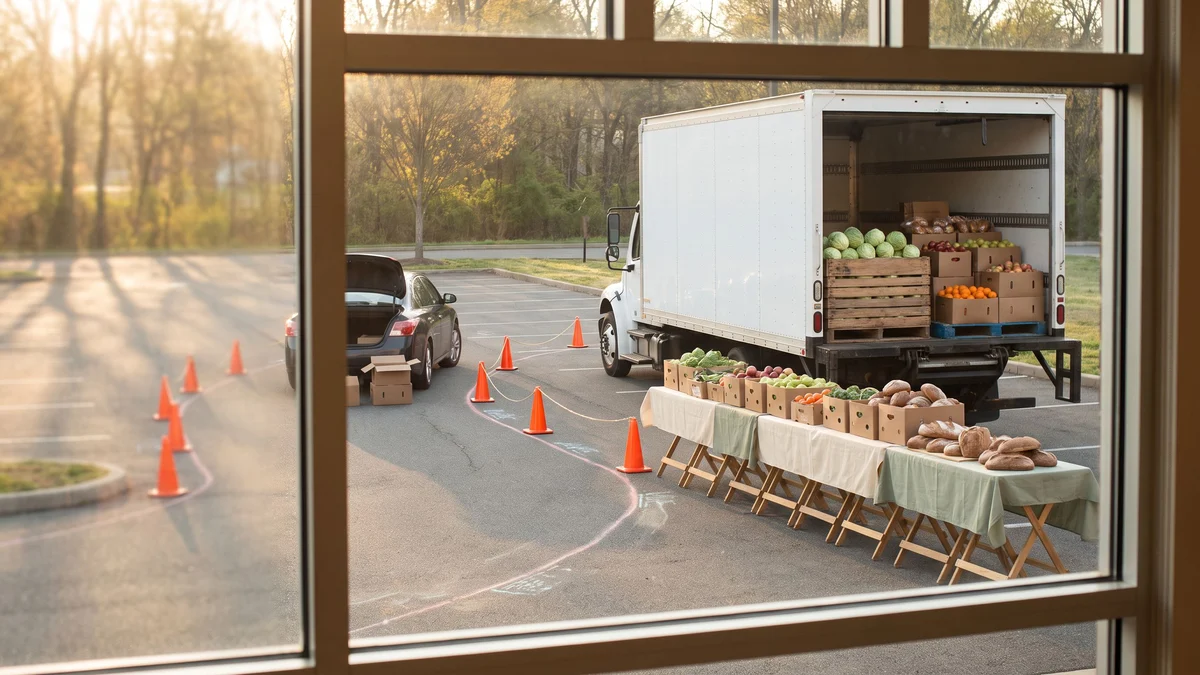
A mobile food pantry is a truck or trailer that brings free groceries to a set place on a set schedule. Feeding America says it usually visits a community once a week or once a month, and anyone who needs groceries can go.1 Food banks help run them, so the fastest way to find one is your local food bank's calendar or the mobile food pantry listings on PantryPath.
What is a mobile food pantry?
A mobile food pantry is a food bank program that takes food to people instead of asking them to come to a building. Feeding America puts it this way: at a traditional food pantry you go to them, and at a mobile pantry the truck goes to you.1
The trucks serve places traditional pantries do not reach. Utah Food Bank sends its mobile pantries to food deserts and other underserved areas.2 A food desert is an area where residents have no healthy, affordable food store nearby and not enough transportation to reach one.2
USDA's Economic Research Service maps this kind of gap. Its Food Access Research Atlas maps census tracts by income and by how far residents live from a SNAP-authorized store or a large food retailer.3 PantryPath's food desert maps show how that looks by state.
How does a mobile food pantry work?
A food bank sends a truck to a site it arranged in advance, local volunteers set up, and food goes out at the posted time. Food Bank of Iowa describes four steps:4
- A truck delivers produce, meat, bread and nonperishable items to the prearranged site.
- Local volunteers set up a farmers market-style distribution.
- Food goes to people at the scheduled time.
- Volunteers reset the space to its original condition when the food is gone.
The site is usually a partner. Mid-South Food Bank runs its mobile pantries through local organizations that serve as host sites, using refrigerated vehicles.5 Feeding America says typical hosts are churches, community centers, schools and shopping centers.1
Food is available while supplies last, so arrive early.5
Why do food banks run mobile pantries?
They reach people who live too far from food, and they help places where a pantry cannot store much. Utah Food Bank says some local pantries lack storage space or refrigeration, so a truck is an efficient way to deliver fresh produce and other perishable items.2 Its page also says that last year it served 557,815 people through 697 mobile pantry distributions at 43 sites.2
Food banks pick sites by need. St. Louis Area Foodbank picks mobile market sites using several criteria, including ZIP codes with food insecurity of 15% or higher, poverty of 30% or higher and unemployment of 15% or higher.6 Mountaineer Food Bank in West Virginia says the counties it serves depend on funding, food resources and partner support. Its mobile pantry aims at areas where a local agency does not exist or needs more help.7
Is a mobile pantry drive-through or walk-through?
Both exist, and your food bank's page will say which one it uses. For a general view of the drive-through style, see our guide to drive-through food pantries.
| Style | What you do | Example |
|---|---|---|
| Drive-through | Stay in your car. Volunteers place a prepackaged box or bag in your trunk or back seat. | Food Bank of Iowa4 |
| Walk-through, pick your own | Walk through a trailer or a line and choose what you need. Volunteers help with carts or wagons. | St. Louis Area Foodbank, Food on the Move6 |
| Outdoor market style | Choose fresh produce, pantry staples and frozen protein at an outdoor stop. | Food Bank For NYC8 |
Feeding America notes that some mobile pantries hand out pre-packed boxes while others let you choose, so ask the host which you will find.1
What do food pantries usually give you at a mobile stop?
You usually get meat, fruits and vegetables, dairy, bread and ingredients for easy meals. Some sites add personal care items such as laundry detergent or soap.1 Food Bank For NYC says every stop has seasonal fresh produce and shelf-stable goods. Depending on donations, you might also see diapers, baby food, personal care items, pet food or holiday items.8
Some sites limit what each household takes. Mountaineer Food Bank gives one food box per vehicle so there is enough for everyone in line.7
Do you need ID, proof of income or an appointment?
Usually you do not need to apply or book, but the rules differ by food bank. Feeding America says there is nothing to sign up for. Staff may ask where you live and how many people are in your family, and you may need to show ID or something with your address.1
- No verification: St. Louis Area Foodbank's Food on the Move walk-through trailers do not require verification of personal information.6
- Basic details: Mid-South Food Bank asks for your name, household size, county, state and ZIP code, plus household income or assistance program information.5
- Income limits: Mountaineer Food Bank asks for your name, address, phone number and household size, and you must meet its income guidelines. For a household of four, the limit is $4,957 in gross monthly income, as listed on October 30, 2026.7
- Annual form: At sites that give out USDA foods through The Emergency Food Assistance Program (TEFAP), HACAP in Iowa has you sign a form once a year.9 TEFAP is a federal program that gives USDA Foods to states to supplement the diets of people with low income.10 See our TEFAP guide for how it works.
Food Bank For NYC does not take reservations for its mobile pantries. Every distribution is first-come, first-served, except some donor-sponsored events where food may be pre-bagged.8 Our directory shows a similar pattern: only 73 of 1,095 mobile pantry listings are marked by appointment.12
What should you bring, and how early should you arrive?
Bring something to carry food and the details a sign-in might ask for. Then plan to arrive about 30 minutes early.
- A reusable bag or a cart to carry groceries home.8
- A clear trunk or back seat if the site is drive-through.4
- Household details: name, address, phone number and the number of people in your home.7
- ID or mail with your address, in case staff ask.1
Food Bank For NYC suggests lining up 30 minutes before the start and says there is no need to arrive hours early.8 Check the schedule again before you leave. Feeding America warns of last-minute cancellations and changes.1 For general manners and what to expect at any pantry, read what to expect at your first food pantry visit and our food pantry etiquette tips.
How do you find a mobile food pantry schedule?
Start with the food bank that serves your area, because it runs or knows about the trucks.
- Find your food bank. Feeding America says to search by ZIP code. Even if the food bank looks far away, it probably knows the pantry closest to you.1
- Open its mobile pantry calendar. Formats vary. Food Bank of Iowa lets you browse a weekly schedule for 30 counties, and most sites are open once a month.4 Mid-South Food Bank updates its schedule daily.5 HACAP posts a monthly schedule file.9
- Call 211. The 211 line helps people find food and other local resources, and your local 211 can be found online.11 Our 211 guide explains what to ask.
- Browse PantryPath. Use the mobile food pantry listings to see sites by state, and the food distribution schedule for upcoming events.
How many mobile pantries are in the PantryPath directory?
PantryPath lists 1,095 of its 7,197 confirmed US pantries with the mobile pantry service, about 15% of the directory. They appear in all 50 states and DC. About two-thirds, 720 listings, also list walk-in access.12
These five states have the most mobile pantry listings (as of October 30, 2026):
| State | Mobile pantry listings | All listings | Share |
|---|---|---|---|
| Texas | 77 | 373 | 20.6% |
| New York | 76 | 542 | 14.0% |
| California | 72 | 602 | 12.0% |
| Florida | 68 | 324 | 21.0% |
| Washington | 48 | 270 | 17.8% |
Share is a state's mobile pantry listings divided by all of its listings. Among states with at least 40 listings, the highest shares are Iowa (24.0%, 31 of 129), Kansas (23.5%, 27 of 115) and Utah (23.3%, 14 of 60).12 A listing shows that a site or program exists, not how often a truck runs, so confirm the date with the host.
Frequently Asked Questions
What is the difference between a mobile food pantry and a mobile food bank?
People use the two terms for the same service. Feeding America's page covers both under one title.1 A food bank is a storehouse whose food goes out through pantries, schools and other programs, and HACAP lists its mobile food pantry among those programs.9 Our guide to how food banks work explains where the food comes from.
Is a mobile food pantry free?
Yes. Mobile pantries bring free food and groceries to your community.1 Some food banks set income or household rules, as Mountaineer Food Bank does.7
Is there a limit on how many mobile pantries you can go to?
Not usually, but limits can come from each host. Food Bank For NYC says many families visit several of its mobile pantry sites in a month.8 HACAP has no service limits at its Food Reservoir, though a specific pantry may limit visits because of its supplies. If you need more food, HACAP suggests visiting another pantry.9
Can I pick up food for someone else?
It depends on the food bank. Mountaineer Food Bank allows it if the other household meets income guidelines and you have their name, address, phone number and household size.7 Ask your food bank before you go.
Do mobile pantries cancel in bad weather?
Some do not. Food Bank For NYC says it is there rain or shine and posts changes on its page.8 Mid-South Food Bank says dates, times and locations can change or be canceled, so check its schedule that day.5
Does a mobile food pantry offer emergency food box delivery?
Usually no. The truck comes to a site, not your door. HACAP does not deliver, although a few of its partner pantries offer home delivery in some situations.9 Call the pantry nearest you to ask.
How can I volunteer at a mobile pantry?
Ask your local food bank, since mobile pantries rely on local volunteers to set up the site and reset it afterward.4 Our volunteer page and guide to volunteering at a food bank can help you start.
How we checked this
On October 30, 2026 we opened each cited page and confirmed it states the fact we attribute to it. The sources are the Feeding America mobile pantry page, six food bank mobile pantry pages (Utah, Iowa, Mid-South, St. Louis, Mountaineer and New York City), HACAP's Food Reservoir page, two USDA pages and the 211 site. Rules and schedules differ by food bank, and we did not test any site in person.
The directory figures come from PantryPath's confirmed pantry listings with a valid US state code (n=7,197, queried October 30, 2026).12 A listing counts as mobile when it carries the mobile pantry service tag. Listings with a missing or non-US state were left out. We took the Mountaineer Food Bank income limits from its own page and did not check them against another source.
Next step: open the mobile food pantry listings, choose a site, and confirm the date and time with the host before you go.
Sources
- Mobile Food Pantries · Feeding America (2026)
- Mobile Pantry Program · Utah Food Bank (2026)
- Food Access Research Atlas · Economic Research Service, U.S. Department of Agriculture (2026)
- Mobile Pantry Program · Food Bank of Iowa (2026)
- Mobile Pantry Distributions · Mid-South Food Bank (2026)
- Food Distribution Events and Programs · St. Louis Area Foodbank (2026)
- Mobile Food Pantry FAQs · Mountaineer Food Bank (2026)
- Visit a Mobile Pantry · Food Bank For NYC (2026)
- HACAP Food Reservoir · Hawkeye Area Community Action Program (HACAP) (2026)
- The Emergency Food Assistance Program · USDA Food and Nutrition Administration (2025)
- Call 211 for Essential Community Services · United Way 211 (2026)
- PantryPath directory analysis (n=7,197, queried 2026-10-30) · PantryPath (2026)
Find a Food Pantry Near You
Search our directory of 7,000+ verified food pantries and food banks across the United States.