How Do Food Banks Work? Where the Food Comes From and Where It Goes
How do food banks work? Follow the food from farms, stores and USDA to the pantry shelf, see who pays for what, and learn who can get food. Checked October 2026.
Part of the complete guide
TEFAP (Emergency Food) →
Quick answer: A food bank collects donated, rescued, purchased and USDA food, stores it in a warehouse, and ships it to local partners such as pantries, soup kitchens and shelters.1 Federal food reaches food banks through state agencies under The Emergency Food Assistance Program (TEFAP).2 Most people get groceries from a pantry that a food bank supplies.3
Below: what a food bank is, the five steps from warehouse to your bag, where the food comes from, who pays for what, and who can get food. For the short version of the difference, see our food bank vs food pantry post.
What is a food bank?
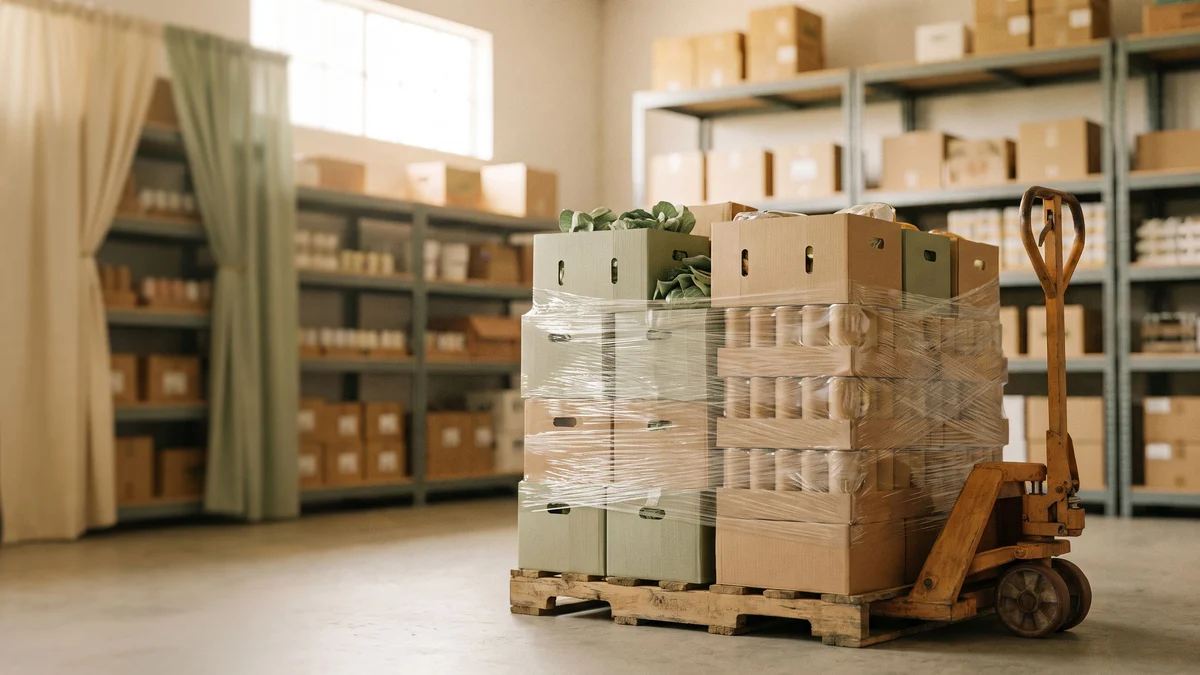
A food bank is a nonprofit warehouse and delivery hub for donated food. It supplies food pantries and meal programs, which hand the food to people.1 Feeding America says its network has 200 food banks and 60,000 food pantries and meal programs, and reaches more than 46 million people a year.1
A food pantry is a different kind of place. It is an independent, often volunteer-run community space that gives families food supplied by a food bank.3 Pantries often sit in churches, community centers and schools.4
How does food get from a food bank to your pantry?
Food moves through five steps. Details differ by food bank, but the order is the same.
- Food arrives. It comes from retailers, manufacturers, farms, federal programs, food drives and purchases (see the next section).
- Staff and volunteers inspect, sort and store it. Warehouses use pallet racking, commercial coolers and freezers.4
- The food bank decides who gets what. One Virginia food bank says it allocates food across partner agencies based on need, capacity and geography.4
- Pantries order or pick up. Pantries place orders and receive deliveries.4 Some urban food banks have a "shopping floor" where pantry partners pick out their own orders.3
- The pantry gives food to you. Many pantries now let visitors choose items from shelves, much like a small grocery store.4
The loop also runs backward. Pantries see rising need first, and they tell the food bank, which can send more food, add distributions or sign up new partners.4
Where do food banks get their food?
From several streams at once, and the mix differs by food bank. Feeding Florida's network moved more than 400 million pounds of food in a recent fiscal year.5 One member, Second Harvest of the Big Bend, brought in a little over 20 million pounds. Of that, 24% came from federal programs (TEFAP or the Commodity Supplemental Food Program), about 5% from purchases, and the rest, about 71%, from donations and farms.5 Treat that as one example, not a national average.
| Source | How it reaches the food bank |
|---|---|
| USDA Foods | USDA buys foods and offers them to state agencies, which pass them to local agencies, usually food banks.2 |
| Manufacturers and grocers | One Florida food bank books freight to pick up from manufacturers and distribution centers, and its fleet or partner agencies collect grocery donations.5 |
| Farms and gleaning | Farmers donate, and volunteers glean (collect) excess fresh produce from farms and gardens.6 One Florida food bank runs a small seasonal gleaning program.5 |
| Food drives and households | Households can donate wholesome food to local food banks and pantries.6 |
| Purchases | Food banks buy food when donations fall short. A Florida food bank said many of its purchases are grant-funded and restricted to food.5 |
Federal law helps donors say yes. The Bill Emerson Good Samaritan Food Donation Act protects people who donate apparently wholesome food in good faith to a nonprofit from civil and criminal liability for its condition.6 Our post on donating expired food and the law has the details.
How does USDA food reach a food bank?
Through TEFAP. USDA buys foods and makes them available to state distributing agencies. The amount each state gets depends on its number of unemployed people and people living below the poverty level.2 State agencies give the food to local agencies they select, usually food banks, which pass it to soup kitchens and pantries.2 More than 130 products are available, from canned and fresh produce to meat, eggs, grains and dairy.2
States also receive administrative funds for storing and distributing the food, and part of that money must go down to local agencies.2 In fiscal year 2024, TEFAP received $461.5 million to buy USDA Foods and $80 million for administrative costs.2
On top of that, TEFAP distributes "bonus" foods that USDA buys to support agricultural markets.2 On October 29, 2026, USDA announced its intent to buy up to $472.5 million of commodities under Section 32. The food is meant for the charitable food network and other nutrition assistance programs, and $165.5 million of it is dairy.7 The announcement does not say when the food reaches any one local food bank.
Two federal rules matter to you. States must not charge eligible recipient agencies for USDA Foods, or assess fees for distributing them.8 And an organization giving USDA Foods to households for home use must limit it to households that meet the state's eligibility criteria.8 The program page on TEFAP and emergency food covers eligibility.
Do pantries pay food banks for food?
Sometimes, a little. Feeding Wisconsin says its food banks may charge partner pantries a shared maintenance fee per pound on some food, to defray the cost of sourcing, transporting, storing and delivering it. The fee never exceeds 19 cents per pound, and partner pantries must offer food to you at no cost.9
Other food banks report the same pattern. A Colorado food bank wrote in 2016 that about 87% of the food it distributed carried no fee, and that agencies paid an average of $0.023 per pound once free food was counted.10 That post is old, so use it as an illustration, not a current price. USDA Foods carry no state charge.8
Why does money go further than cans?
Moving food costs money. Feeding America calls donating money the most effective way to help food banks, because it covers staff salaries, gas for delivery trucks and repairs when refrigerators and freezers break.11 Feeding America also says every $1 donated to it helps secure at least 10 meals, thanks to partnerships with manufacturers and retailers.12 That is the organization's own figure.
A Colorado food bank gave a sense of scale in 2016. It paid $2,000 to $4,000 to ship one truckload of donated food to Colorado, and $2,000 to $6,000 in processing fees on a produce load, plus transport.10 Food still matters, especially items your local pantry asks for. Our guide to the best foods to donate to a food bank lists them.
What else do food banks do besides supply pantries?
Many run programs of their own. No Kid Hungry lists SNAP and WIC application help, cooking classes, job training, free health screenings, and summer and afterschool meals.3 Some also run mobile distributions and school-based pantries for people who live far from a pantry.4 You can browse the pantry services in the directory to see which offer them.
Can anyone go to a food bank to get food?
Usually you go to a pantry that a food bank supplies, and the rules depend on the pantry. Some pantries have no requirements and do not ask for proof of income or ID. Others apply income limits, such as those a state emergency food program sets. Some ask your ZIP code and household size for record-keeping.3
When a pantry gives out TEFAP food for home use, the state sets the income guidelines, and a state may count your participation in another income-based program.2 Prepared meals, such as at a soup kitchen, are not means-tested.2 Our posts on ID requirements and your first pantry visit cover what to bring. To find a pantry, search the PantryPath directory.
Who runs the pantries in the PantryPath directory?
Mostly nonprofits and churches. We checked the 7,566 confirmed listings in the directory on October 29, 2026.13 A listing can carry more than one type, so the shares add up to more than 100%.
| Organization type | Listings | Share of 7,566 |
|---|---|---|
| Nonprofit | 5,280 | 70% |
| Church | 3,228 | 43% |
| Food bank | 868 | 11% |
| Food pantry | 523 | 7% |
| Community organization | 234 | 3% |
| Government | 134 | 2% |
| School | 69 | 1% |
As of October 29, 2026. Types come from each listing's public information, so some listings are untyped.13
The 868 food bank listings are confirmed food distribution sites, so you may be able to get food there. Check hours first with the pantry schedule.
How often can you come back? Of the 3,157 listings that state a visit limit, about 1,720 (54%) say once a month, about 385 (12%) say twice a month and about 664 (21%) say weekly. The rest use other wording.13 We matched the wording with text patterns, so treat the counts as approximate.
Frequently Asked Questions
Are food banks free?
For you, yes, at the networks we checked. Feeding Wisconsin says its partner pantries must offer food to visitors at no cost.9 In the PantryPath directory, 7,004 of the 7,065 listings that state a cost model say free (99%).13
Can I go to two food pantries in one day?
Each pantry is independent and sets its own rules.3 Where a pantry gives out TEFAP food, the state sets the eligibility criteria.2 Ask each pantry about its visit limit. Our post on how often you can go to a food pantry explains the usual patterns.
Do food banks ask for income?
Some pantries do, and some do not.3 For TEFAP food taken home, households must meet the state's income guidelines.2
Do you just show up to a food pantry?
Often yes, during open hours. Pantries may open weekly, monthly or on certain days.4 Of the 5,368 listings that say whether you need an appointment, 619 (12%) say by appointment.13 Call or check the listing before you go.
Are food banks run by the government?
No. Food banks are nonprofit facilities.3 The government supplies part of their food through TEFAP and state agencies.2 Of the directory's listings, 134 (2%) are government-run.13
Where do food banks get their funding?
From donors and from public money. Cash donations cover costs such as staff, fuel and repairs.11 States receive federal administrative funds for TEFAP and must pass part of them down to local agencies.2 Feeding America also gave its network members $244 million in 2022 for training, refrigeration, transportation and technology.1
What is the most requested item at a food bank?
It differs by food bank, so ask yours. Most accept canned or dried food that has not passed its sell-by date.11 Our guide to the best foods to donate has the common picks.
How can I help a food bank?
Give money, give the food your local food bank asks for, or give time. Feeding America says most network food banks welcome volunteers.12 Our volunteer page shows how to start. Churches and groups that want to open a pantry usually partner with a food bank; see how to start a food pantry.
How we checked this
On October 29, 2026, we opened every source listed below. They include the USDA Food and Nutrition Administration TEFAP fact sheet (last updated August 11, 2026), the federal TEFAP regulations and USDA's October 29 purchase announcement. We also read Feeding America, Feeding Florida, Feeding Wisconsin, No Kid Hungry and two food banks.
We queried the PantryPath directory the same day (confirmed listings with a state, n=7,566).13 Food bank examples show how individual food banks work, not national averages, and the Colorado figures date from 2016. The page with USDA's fiscal year 2026 TEFAP funding amounts did not load as readable text, so we use the fiscal year 2024 figures. We did not interview food bank or pantry staff or visit a warehouse for this guide.
Next step: find a food pantry near you, or read how TEFAP supplies the food on its shelves.
Sources
- The Feeding America network · Feeding America (2026)
- TEFAP Fact Sheet · USDA Food and Nutrition Administration (2026)
- What is a Food Bank vs Food Pantry? · No Kid Hungry (2023)
- Food Bank vs. Food Pantry: What's the Difference? · Foodbank of Southeastern Virginia and the Eastern Shore (2026)
- SERIES: How Does a Food Bank Get Food? · Feeding Florida (2025)
- Donating · U.S. Department of Agriculture (2026)
- USDA Announces $472.5 Million Food Purchase to Support U.S. Producers and Strengthen America's Food Supply · U.S. Department of Agriculture (2026)
- 7 CFR Part 251, The Emergency Food Assistance Program · Electronic Code of Federal Regulations (2026)
- FAQs · Feeding Wisconsin (2026)
- Do we charge for our food? · Care and Share Food Bank for Southern Colorado (2016)
- Donate Food · Feeding America (2026)
- Team Feed Corporate Support Materials (FAQ) · Feeding America (2026)
- PantryPath directory analysis (n=7,566 confirmed listings; queried 2026-10-29) · PantryPath (2026)
Find a Food Pantry Near You
Search our directory of 7,000+ verified food pantries and food banks across the United States.