What Is a Soup Kitchen? How It Works and Its Great Depression Roots
Free hot meals served on site: what a soup kitchen is, how it differs from a pantry or food bank, who can eat there, and its Great Depression history.
Part of the complete guide
Emergency Food Assistance →
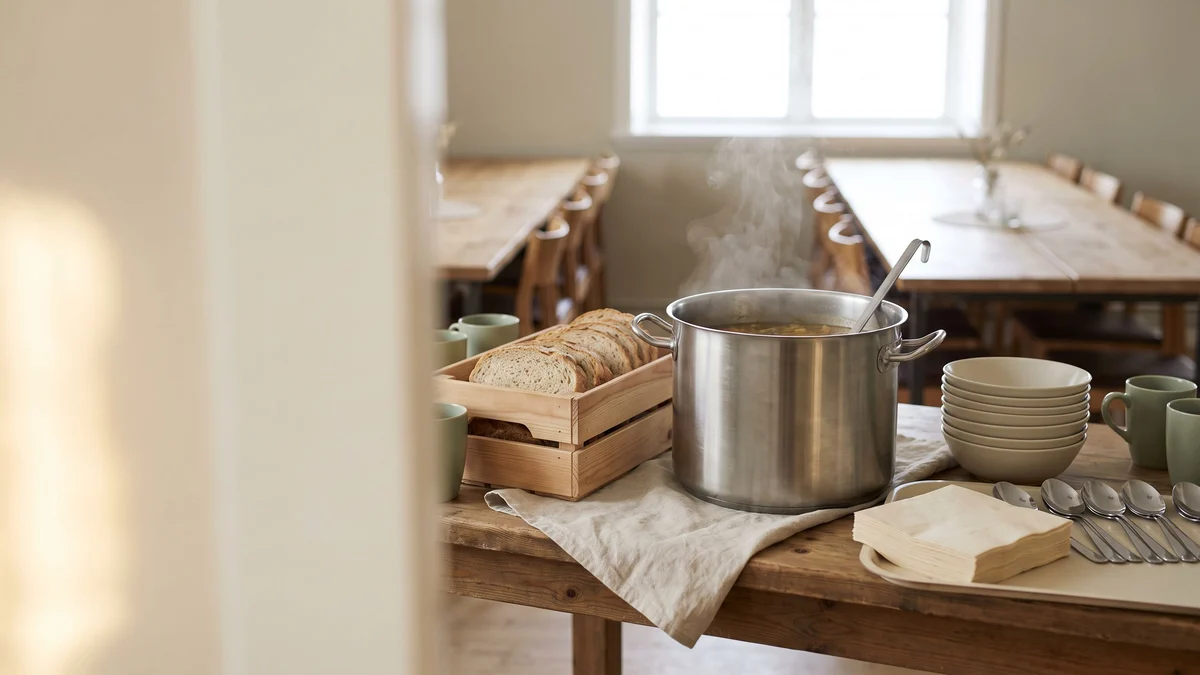
Quick answer: A soup kitchen is a charity or public institution that serves free prepared meals on a regular basis. Federal rules describe one as an institution with "an established feeding operation to provide food to needy homeless persons on a regular basis."1 You eat the meal there, unlike at a food pantry, where you take groceries home.
Soup kitchens became a national symbol in the Great Depression, when they provided the only meals some unemployed Americans had.2 If you need food today, start with our emergency food assistance guide.
What is a soup kitchen?
A soup kitchen is a place that serves hot or prepared meals to people who are hungry, usually at no cost. The federal food program rules group soup kitchens with food banks and food pantries as "emergency feeding organizations."1 Feeding America calls the meal sites in its network "meal programs."3
The food usually arrives through two channels:
- Food banks. Network food banks collect, sort and distribute donations from farmers, manufacturers, retailers and government agencies to local pantries and meal programs, which serve it directly to people.3
- The federal government. USDA provides American-grown USDA Foods and administrative funds to states to run The Emergency Food Assistance Program (TEFAP), and soup kitchens are one of the agency types that can take part.41 Our TEFAP guide explains how it works.
Soup kitchen vs food pantry vs food bank: what is the difference?
A soup kitchen serves meals you eat on site, a food pantry gives you food to take home, and a food bank supplies both. Federal rules use these definitions.1
| Place | What it does | How you use it |
|---|---|---|
| Soup kitchen | Runs a regular feeding operation that serves prepared meals1 | Sit down and eat on site |
| Food pantry | Distributes food to low-income and unemployed households1 | Pick up food to cook at home |
| Food bank | Provides food to pantries, soup kitchens and other feeding centers1 | Reach it through the pantries and meal programs it supplies3 |
Some organizations run a meal line and a pantry under one roof, so read each listing to see what it offers. The full comparison is in our post on food bank vs food pantry.
Can anyone go to a soup kitchen?
Most people can walk in during meal hours, but each kitchen sets its own rules. Federal TEFAP rules require meal sites to serve "predominantly needy persons," and they bar states from requiring a meal site "to employ a means test to determine that recipients are needy."5 In plain terms, a kitchen that takes part in TEFAP does not have to check your income.
ID is a separate question. Among the soup kitchens in the PantryPath directory that record an answer, most say they do not ask for it (numbers in the section on today's kitchens below).6 Before you go:
- Check the meal times, since kitchens serve on set schedules.
- Ask whether the meal is sit-down or to-go.
- Ask whether you need ID or to sign in.
- Mention food allergies or dietary needs when you call.
Where did soup kitchens come from?
The idea is more than 230 years old. Benjamin Thompson, an American-born reformer who became Count Rumford, is normally credited as its inventor.7 As Bavaria's interior minister, he ordered the arrest of Munich's beggars on January 1, 1790, put them to work in a new workhouse and fed them there.7 He worked out that soup was a more efficient way than bread to feed the workhouse, and he set up industrial-scale soup kitchens using boilers he designed.7
Rumford described the meal himself: "a very rich soup of peas and barley, mixed with cuttings of fine white bread," plus a piece of rye bread.8
The idea reached London next. He opened the first soup kitchen in England at the Foundling Hospital in March 1796, and soup charities for the urban poor, selling soup at a penny a quart, opened in Spitalfields in 1797.7 Those charities sold tickets so organizers could screen applicants.7 Modern federal rules go the other way and bar states from requiring a means test at meal sites.5
Soup became the standard charity meal because it is one of the most economical ways to feed a large group, according to Smithsonian magazine.8 The Salvation Army's red holiday kettles, in use since 1891, represent soup pots.8
What were soup kitchens like during the Great Depression?
Unemployment reached nearly 25 percent.10 For some jobless Americans, a soup kitchen during the Great Depression offered the only meals they had.2 Soup kitchens and breadlines were the most visible response.
How long did the Great Depression last?
The Great Depression began in August 1929 and ended during World War II in 1941, the longest and deepest downturn in U.S. history.9
Why did people line up for soup and bread?
Federal help was extremely limited, and private groups carried most of the load.10 In New York City, charities and churches served about 85,000 people a day.10 President Hoover believed too much federal intervention would undermine the self-reliance of the American people.11 Rising relief loads in 1930 and 1931 placed what a Social Security Administration historian called "an impossible burden" on local and municipal finances.11
By 1932, men who had been jobless since the end of 1929 stood in long lines before soup kitchens.11 The same account describes bread lines in many places and Hoovervilles, groups of tar paper shacks where homeless people lived, on vacant lots at the edge of town.11
What did Depression soup kitchens serve?
The best-documented menu is from Al Capone's Chicago kitchen. It served coffee and sweet rolls for breakfast, soup and bread for lunch, and soup, coffee and bread for dinner.12
Did Al Capone start the first soup kitchen?
No. His kitchen opened in November 1930 at 935 South State Street in Chicago and served an average of 2,200 people a day, with 5,000 served on Thanksgiving 1930.12 That is 140 years after Rumford's Munich workhouse.7 HISTORY reports that no one was asked to prove need, and that Capone may not have paid for the food, relying instead on extortion and bribes of businesses to donate it.12 The Social Security Administration uses a photo of his kitchen to illustrate the era.2
How did the government's role change?
| When | What happened |
|---|---|
| July 1932 | Hoover approved a measure letting the Reconstruction Finance Corporation lend $300 million for relief11 |
| May 1933 | The Federal Emergency Relief Administration began making grants to states for work relief and direct relief11 |
| Mid-1933 | About half the states had appropriated funds for emergency relief11 |
| 1933 | The Federal Surplus Relief Corporation began directing surplus farm products to needy families10 |
| Today | USDA supplies USDA Foods through states under TEFAP4 |
For the history of the grocery side of this story, see our post on the history of food stamps.
Do soup kitchens still exist today?
Yes. Feeding America describes a network of about 200 food banks and 60,000 food pantries and meal programs.3 In the PantryPath directory, 174 of 7,566 confirmed listings (queried October 28, 2026) have "soup kitchen" in the name.6 These five states have the most:
| State | Listings with "soup kitchen" in the name |
|---|---|
| New York | 22 |
| Florida | 14 |
| Massachusetts | 11 |
| Michigan | 10 |
| Pennsylvania | 9 |
This count is a floor. Many sites that serve meals use another name, and the directory counts only listings we have confirmed. Of the 174, 59 record an ID answer: 39 say ID is not required and 20 say it is.6 Treat that as a guide and confirm with the site.
How do I find a free meal today?
Use a directory first, then a hotline, then call the site to confirm.
- Search the directory. Search PantryPath for soup kitchens by city or ZIP code, or check what is open today.
- Call 211. The 211 network connects you to local help, and every call is confidential.13 See our 211 guide.
- Call the National Hunger Hotline. Dial 1-866-3-HUNGRY (1-866-348-6479), Monday to Friday, 8:00 a.m. to 8:00 p.m. ET. Staff find meal sites, food banks and other services near you. You can also text 914-342-7744 with a word such as "food."14
- Call ahead. Confirm meal times, whether it is sit-down or to-go, and what ID or sign-in the site asks for.
If you are sleeping outside or in a car, our guide for people without a fixed address and our post on food pantries for people experiencing homelessness cover meals, showers and other help.
Frequently Asked Questions
Is a soup kitchen a non-profit?
Many are nonprofits or church programs, and some are run by public agencies. A kitchen that takes part in TEFAP must be public or a private organization with tax-exempt status, and groups organized for religious purposes are automatically tax exempt.51
Do soup kitchens require ID or proof of income?
Not by federal rule. States cannot require TEFAP meal sites to run a means test.5 Individual sites can still ask you to sign in or show ID, and 20 of the 59 soup-kitchen listings in our directory that record an answer say they do.6 Call first.
Why is it called a soup kitchen?
Because soup is one of the most economical ways to feed many people.8 Rumford's workhouse meal was a soup of peas and barley,8 and Capone's Depression-era kitchen served soup with bread.12
What is another name for a soup kitchen?
Feeding America calls these sites meal programs.3 Federal rules call the wider group of food banks, food pantries and soup kitchens emergency feeding organizations.1
How we checked this
We opened every source listed below on October 28, 2026.
- Rules: definitions and eligibility come from the eCFR text of 7 CFR 251.3 and 251.5, current as of October 27, 2026.15
- History: the Social Security Administration, the Federal Reserve, Smithsonian Magazine, HISTORY and the History of Economic Thought Website.
- Not verified: we could not check the unemployment figure against the Bureau of Labor Statistics, so the "nearly 25 percent" is as reported by Living New Deal.10 HISTORY's account of the Capone kitchen relies on 1930s newspaper reports.12
- Directory data: a PantryPath query of confirmed listings with "soup kitchen" in the name on October 28, 2026. Listings that serve meals under another name are not counted.6
Need a meal now? Search the PantryPath directory. Want to help a kitchen near you? See our volunteering page.
Sources
- 7 CFR 251.3 Definitions (The Emergency Food Assistance Program) · Electronic Code of Federal Regulations (2026)
- Soup Kitchens (Social Security History) · Social Security Administration (2026)
- The Feeding America network · Feeding America (2026)
- The Emergency Food Assistance Program · USDA Food and Nutrition Administration (2025)
- 7 CFR 251.5 Eligibility determinations · Electronic Code of Federal Regulations (2026)
- PantryPath directory analysis (n=7,566 confirmed listings, queried 2026-10-28) · PantryPath (2026)
- Benjamin Thompson, Count Rumford · History of Economic Thought Website (2026)
- Count Rumford and the History of the Soup Kitchen · Smithsonian Magazine (2010)
- The Great Depression · Federal Reserve History (2013)
- Making Ends Meat · Living New Deal (2021)
- Abe Bortz Lecture on the History of Social Security · Social Security Administration (2026)
- Mobster Al Capone Ran a Soup Kitchen During the Great Depression · HISTORY (A&E Television Networks) (2025)
- Call 211 for Essential Community Services · United Way Worldwide (211) (2026)
- USDA National Hunger Hotline · USDA Food and Nutrition Administration (2025)
Find a Food Pantry Near You
Search our directory of 7,000+ verified food pantries and food banks across the United States.