Weekend Backpack Programs: How They Work and How to Sign Up
A weekend backpack program sends free, easy-to-make food home with kids on Fridays. See how they work, what is in the bag, and how to get your child signed up.
Part of the complete guide
Free School Meals →
Quick answer: A weekend backpack program sends free, kid-friendly, easy-to-prepare food home with school children on Fridays or before a school break.1 Food banks partner with schools, Boys and Girls Clubs and community centers to run them, and every program is unique.1 To sign up, ask your child's school counselor or your local food bank. For the meals schools serve during the week, see our free school meals guide.
What is a weekend backpack program?
A weekend backpack program covers the days school meals do not. The National School Lunch Program provides low-cost or free lunches to children each school day.2 School meals fill an important gap during the week but cannot meet needs outside school hours.3
These programs began in 1995 at a single Arkansas elementary school.3 Feeding America says its network now hosts over 10,000 backpack programs across the United States.1 The name changes by place. One North Carolina food bank calls its version the Weekend Power Pack.4
How does a weekend backpack program work?
Most programs follow the same four steps.
- A food bank or nonprofit partners with a school or youth site. Food banks work with schools, Boys and Girls Clubs and community centers.1 One food bank required a community partner, often a church, to commit to sponsoring at least 50 students and to pack, store and deliver the food to the school.3
- Volunteers pack the bags. They also set up distributions and pass out backpacks to students.1
- Children get a bag on a set day. Most programs hand out backpacks every week on Fridays or the day before a school break.1 In North Carolina's Weekend Power Pack, packs go out on Thursday or Friday and children return them the following Wednesday.4
- The schedule is at least monthly. Programs in the Feeding America network must provide food at least once a month.1 The Los Angeles Regional Food Bank gives out backpacks monthly on Thursdays or Fridays.5
Programs differ on frequency, bag size and cost. These examples come from each organization's own page.
| Program | How often | Food per bag | Cost to fund a bag |
|---|---|---|---|
| Feeding America network | At least monthly; most weekly1 | A few healthy meals1 | Not stated |
| Los Angeles Regional Food Bank | Monthly5 | At least six meals5 | $15 per backpack5 |
| Feeding South Dakota | Weekly6 | At least three meals6 | $5 per backpack per week6 |
| Blessings in a Backpack | School-year weekends7 | Ready-to-eat food7 | $175 per child per 36-week year7 |
Cost to fund is what the organization says it takes to supply a bag or a child. Families do not pay.1
What is in a weekend food backpack?
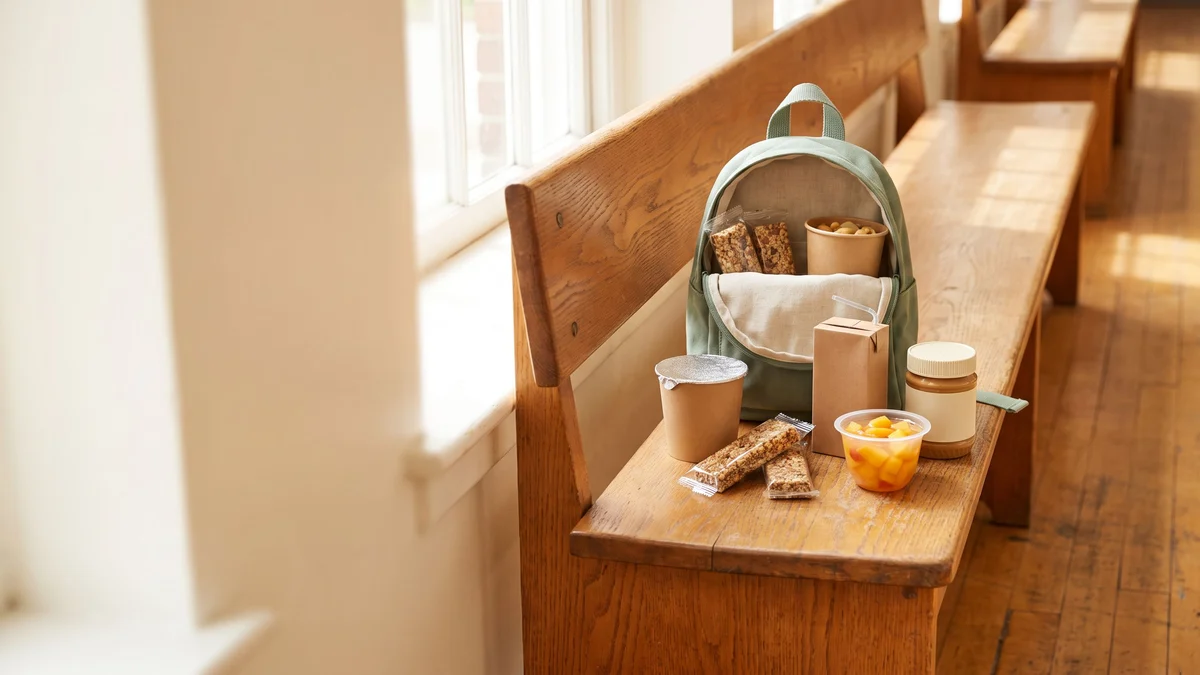
Most backpacks hold enough food for a few healthy meals that a child can make without help.1 Feeding America lists these typical items:1
- Breakfast items such as cereal, oatmeal or granola bars
- Easy meals such as mac and cheese, peanut butter and jelly sandwiches or canned soup
- Bread, milk or juice
- Fresh or canned fruit and vegetables
- Snacks
The Los Angeles Regional Food Bank rotates its menu through items such as oatmeal, peanut butter, whole grain pasta, spaghetti sauce, brown rice, vegetable beef soup, black beans, chunk chicken or tuna, and cereal.5
Some programs adjust the bag to the families they serve. A Minnesota program offered five bag types tailored to ethnic food preferences. Its 49 surveyed caregivers liked 90% of the food items and used all or some of the items in 79% of the bags.8 If you have a dietary or cultural need, ask the program coordinator whether the bag can change.
Who qualifies and how do you sign up?
Rules differ by program, so start with the school. Feeding South Dakota tells families to contact the school's counselor to find out whether the school has a program.6 Feeding America says to ask your school district or local food bank, and notes that a food bank that looks far away works with schools and youth programs closer to you.1
- Ask the school counselor or main office. Ask whether the school hosts a backpack program and how children are enrolled.
- Call your school district if your school has no program. A nearby school may.
- Contact your local food bank. The Feeding America page has a food bank search by ZIP code.1
- Ask four questions: Who chooses the children? What day does the bag go home? Does it also cover school breaks? Can a brother or sister at another school get one?
In the Feeding America evaluation of one Illinois food bank, schools selected the children, and 73% of the households served were food insecure at the start of the school year.9 The evaluators recommended against basing selection only on free or reduced-price lunch status, because that can miss hungry children in more affluent communities.9 For lunch eligibility itself, see our school meals guide and the School Hunger Research Atlas.
What is Blessings in a Backpack?
Blessings in a Backpack is a national 501(c)(3) nonprofit that provides weekend food to school-aged children.7 It reports that it distributed over 2.7 million bags of ready-to-eat food at nearly 1,000 schools during the 2024-2025 school year.7 Since 2009 it has provided 30 million hunger-free weekends for more than one million children, it says.7
The organization describes seven regional chapters and more than 1,200 community-driven programs.7 It has a program locator on its website. Other groups run the same Friday-bag model under their own names. Local organizations such as End 68 Hours of Hunger also run weekend feeding programs, which may differ slightly from Feeding America's.3
Do weekend backpack programs work?
The research is positive but mixed, and it depends on what is measured.
- Test scores. A University of New Hampshire study of 12 North Carolina counties found that having a backpack program raised reading scores for economically disadvantaged students at the school by 0.09 standard deviations.3 Between 10% and 30% of those students took part, so the authors call the estimate conservative.3
- Attendance and food security. In the Illinois evaluation, backpack participation had a small but significant effect on Friday attendance.9 Thirteen percent of backpack families moved from low food security to food secure between October and December, compared with 5% of comparison families who did not get backpacks.9
- Limits. Over 50% of the backpack families in that evaluation stayed food insecure all year.9 Families usually shared the food, and for very low food security households it lasted only through the weekend.9
- A weaker result. A 2013 study of 82 students found no significant drop in self-reported hunger and no significant rise in on-task behavior.10 It also found that 98% of parents said the program helped their family.10 The authors noted that about 75% of participants reported enough food at home over the weekend even before the program started.10
A backpack works best alongside other help. In the Illinois evaluation, 77.9% of served households used SNAP in the previous 30 days and 45.3% used food pantries.9 Our guides to SNAP and WIC cover those programs.
What if your school has no backpack program, or it is not enough?
Look for help that covers the same days, and ask about school breaks and summer.
- Food pantries. In the PantryPath directory, 3,733 of 7,566 confirmed pantries (49%) list families with children among the people they serve.11 Search by city or ZIP code and check the days and hours.
- Ask the school. Only 2 of those 7,566 listings mention backpacks and 15 mention a school.11 Backpack programs usually run through schools, so the school is the better place to ask.
- Summer. Backpack programs usually take a break in summer, though some run summer weekend bags and food banks may host summer meal programs.16 The USDA Summer Food Service Program offers free meals and snacks to children 18 and under at sites such as schools and parks.12 See our summer meals guide and SUN Bucks post.
- More kid-focused help. Our free food for kids and back-to-school food assistance posts list other programs, and the families with children guide covers benefits.
How can you start or support a backpack program?
Action for Healthy Kids gives five steps for starting one at a school:13
- Contact your local food bank to see whether a program already exists and what resources it can provide, then meet with the principal.
- Present at a staff and parent group meeting to build support.
- Set the details: how many children, how to tell families, the budget, and how to pack and hand out bags.
- Recruit volunteers.
- Pack the backpacks and distribute them.
Hunger can be a sensitive topic, so plan distribution so that children who take part feel comfortable and children who do not are not left out.13
Costs add up. In the North Carolina study, the food cost about $5 per pack, or $10,000 to supply 50 packs for the 40 weekends of a school year.3 To become a backpack site, Feeding America says to reach out to your nearest food bank.1 You can also volunteer or run a food drive for your local food bank.
Frequently Asked Questions
Is a weekend backpack program free?
Yes for families. Feeding America describes backpack food programs as offering families free groceries for weekends and school breaks.1 The costs in the table above are what donors and food banks pay to fill the bags.
Do you have to qualify for free or reduced-price lunch?
Not necessarily. Every program is unique, so ask the one near you.1 In the Illinois evaluation, researchers advised against tying selection only to free or reduced-price lunch participation.9
Can a parent sign up directly?
Sources point families to the school first. Contact the school counselor, your school district or your local food bank.61 Ask whether the program takes referrals from parents.
Will other students know my child gets a backpack?
Programs try to prevent it. Action for Healthy Kids advises planning distribution so that participating children feel comfortable and others are not left out.13 A school-based study describes its program as confidential.10
Is the food only for the child?
Backpacks are made for children, but families share them. In the Illinois evaluation most families used the food for family meals.9 In the 2013 study, 60% of children said they shared the food with others at home.10
Do backpack programs run in the summer?
Usually not. Most take a break in summer, and food banks may host summer meal programs instead.1 Feeding South Dakota runs a Summer BackPack Program at participating schools.6
Can a program meet dietary or cultural needs?
Some do. The Minnesota program with five bag types adjusted its food for ethnic preferences, and caregivers used all or some of the items in 79% of the bags.8 Ask the coordinator what options exist.
How we checked this
We reviewed the sources listed below on October 29, 2026, and opened each page to confirm it says what we attribute to it. Program details such as days, meal counts and costs are as each organization published them and vary by location. The Feeding America page says "over 10,000" programs in its text and a higher figure in its page description; we used the text.1 The Illinois evaluation covers one food bank in 2011-2012, and the 2013 study is small, so treat both as examples rather than national results.
The PantryPath numbers come from our directory of 7,566 confirmed pantry listings with a state, queried October 29, 2026.11 "Families with children" is a listed population served. The backpack and school counts match those words in a listing's title, services or items. We did not contact the programs named here.
Your next step: ask your child's school counselor this week whether a backpack program is available. Then browse school meal options and pantries in your area for the days the program does not cover.
Sources
- BackPack Program · Feeding America (2026)
- National School Lunch Program · USDA Food and Nutrition Administration (2025)
- “BackPack” Food Programs Linked to Higher Test Scores for School Children · Carsey School of Public Policy, University of New Hampshire (2021)
- Weekend Power Pack (BackPack) Program · Food Bank of Central & Eastern North Carolina (2026)
- What is the Backpack Program? · Los Angeles Regional Food Bank (2022)
- BackPack Program · Feeding South Dakota (2026)
- How It Works · Blessings in a Backpack (2026)
- Weekend Backpack Program Tailored for Ethnic and Dietary Food Preferences: Nutrition Quality, Program Usage, and Parent Satisfaction · Journal of Nutrition Education and Behavior (via PubMed Central) (2024)
- BackPack Program Evaluation (executive summary) · Feeding America and the University of Illinois Family Resiliency Center (2012)
- The BackPack Food Program’s Effects on U.S. Elementary Students’ Hunger and On-task Behavior · Journal of Child Nutrition & Management, School Nutrition Association (2013)
- PantryPath directory analysis (n=7,566 confirmed listings, queried 2026-10-29) · PantryPath (2026)
- Summer Food Service Program · USDA Food and Nutrition Administration (2026)
- Backpack Programs · Action for Healthy Kids (2022)
Find a Food Pantry Near You
Search our directory of 7,000+ verified food pantries and food banks across the United States.