Community Fridge: How It Works, What to Donate, How to Start One
A community fridge is a free, public refrigerator anyone can take from or stock. Learn how it works, what to donate, the safety rules and how to start one.
Part of the complete guide
Emergency Food Assistance →
Quick answer: A community fridge is a free, public refrigerator that neighbors stock and anyone can take from. Many are open around the clock1 with no paperwork2. If you donate, give sealed or clearly labeled food that is not expired, and keep perishables at 40°F or below.3 If you need more help than a fridge can give, start with emergency food assistance.
What is a community fridge?
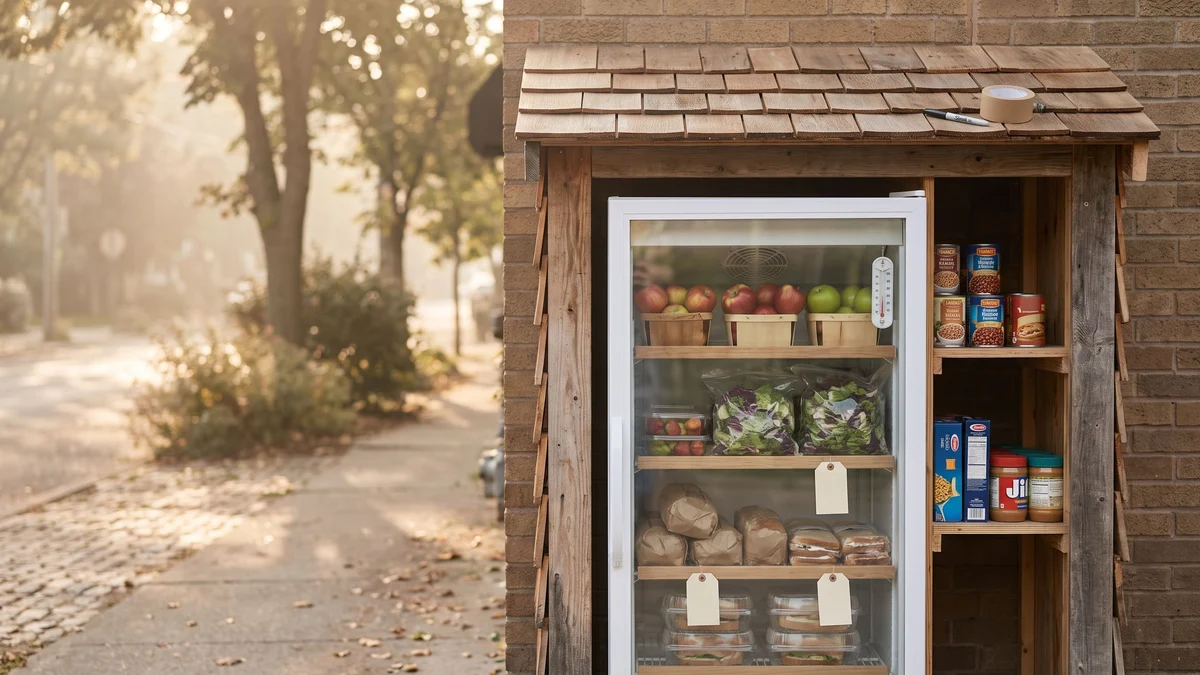
A community fridge, also called a free fridge or freedge, is a community-led food pantry that gives 24/7 access to donated food. Volunteers usually maintain it, and local residents stock it.1 It is typically one or two covered refrigerators, often outdoors and exposed to extreme temperatures, sometimes with dry shelves beside them for canned goods, toiletries or diapers.3 Groups that run them often describe the work as mutual aid, where neighbors look after each other instead of waiting for an institution.4
How does a community fridge work?
A host site supplies the electricity, volunteers keep the fridge clean and stocked, and anyone can drop off or pick up food at any hour. Fridge Finder, a New York City network, says the keys to success are a good host location and a daily maintenance team.5 The Local Food Safety Collaborative recommends a maintenance visit at least once a week.3
In Philadelphia, the Share Food Program says more than 30 community fridges are part of a volunteer network. It says they are open 24/7 and that neighbors are encouraged to donate what they can.2
Community fridge, food pantry or little free pantry?
Unlike a traditional food pantry, a community fridge is typically maintained by volunteers and stocked by the residents of the neighborhood it sits in.1 Our guide to little free pantries and blessing boxes covers the smaller, shelf-stable version of the same idea. A fridge adds cold storage, which is why it needs the temperature rules below.
Can anyone use a community fridge?
Yes, and the food is free. Share Food Program says its network offers free food for anyone, with no paperwork required.2 Denver Community Fridges says its fridges are open 24/7 to the public.4 If you would rather use a staffed pantry that still asks for no ID, see our list of food pantries with no ID and no questions asked.
What can you put in a community fridge?
Give food that is sealed or labeled, unexpired and safe to leave in a fridge that strangers open all day. The Local Food Safety Collaborative suggests packaged fresh produce and prepared meals as ideal, and some organizers encourage donors to cook, portion and label meals for the fridge.3 Rules differ by fridge, so read the sign first.
| Bring | Leave at home | Why |
|---|---|---|
| Packaged fresh produce and labeled prepared meals | Raw meat, shellfish, unpasteurized or raw dairy | Higher food safety risk and cross-contamination3 |
| Commercially made meals from a licensed kitchen (some fridges require this) | Homemade meals at fridges that ban them | Denver Community Fridges accepts prepared meals only from regulated kitchens4 |
| Store-bought canned and boxed goods on a dry shelf | Home-canned jars, jams and sauces | Home canning that strays from USDA methods raises botulism risk6 |
| Meals labeled with the dish name, date made, ingredients and allergens | Leftovers, catering trays, opened or unsealed food others have touched | On the guide's list of donations to avoid3 |
| Packages with lids and original labels intact | Glass, open containers, damaged or tampered packages | Open items spill, and broken glass is a hazard3 |
| Food well within its date | Spoiled, moldy or expired food; frozen food unless the fridge has a freezer | Thawed frozen food can leak and cross-contaminate3 |
Table as of October 29, 2026, drawn from the Local Food Safety Collaborative guide and Denver's posted rules. Your local fridge's rules come first.
Should you donate food that is past its date?
No. Federal rules do not require quality dates on most packaged food, and USDA says those dates are about quality, not safety.6 Fridge guidance still tells donors to skip anything past its "best by" or expiration date, because food can sit in a busy fridge before someone takes it. Baby food and formula should never be used past their dates.3
The FDA backs "Best if Used By" as the standard quality phrase and advises checking food for spoilage past that date.7 Our post on donating expired food covers what the law allows.
Check cans too. USDA says a small dent on an otherwise good can is fine, but a deep dent you can lay a finger into, especially on a seam, means the can should be thrown out.6
What are the food safety rules for a community fridge?
Keep perishable food at 40°F or below, and keep it out of the temperature range where bacteria grow fastest. USDA says bacteria multiply rapidly between 40°F and 140°F, and perishable food left at room temperature for more than two hours (one hour above 90°F) should be thrown away.8 The FDA also says a refrigerator should hold 40°F or below, checked with a thermometer, and should not be overpacked so cold air can circulate.7
For a street-side fridge, the Local Food Safety Collaborative adds these practices:3
- Keep a thermometer inside, and consider a wireless monitor that alerts you when the temperature rises.
- Visit at least once a week, and keep cleaning logs, temperature logs and incident reports on site.
- Use door bungees or a self-closing door so the door stays shut.
- Place the fridge out of direct sun, with ventilation behind and underneath, inside a sturdy shelter.
- Post clear food safety signs, ideally in more than one language, and leave tape and a marker for labeling.
Are community fridges legal?
There is no federal ban, and the rules are mostly set by state and local health departments. The Local Food Safety Collaborative notes that the FDA Food Code gives no specific guidance for community-led food sharing, so a free fridge can still be subject to health inspectors.3 Freedge says health codes were written for restaurants and other food businesses, that inspectors tend to be tolerant of fridges with their own safety rules, and that hosts can sometimes face legal battles. It also says inspections often happen only after a complaint.9
Cities are starting to write fridge-specific rules. Albuquerque's Environmental Health Department says it is working on new rules for the safe handling of food in community fridges. The city already issues food permits at no cost when the purpose is donating food.10 Because the picture changes city by city, call your local health department before you plug one in.
Does the Good Samaritan Act protect a community fridge?
It may protect some donors, but it does not override local health rules. The federal Bill Emerson Good Samaritan Food Donation Act shields people who donate apparently wholesome food in good faith to a nonprofit for free distribution, and shields the nonprofit that receives it.11
Since January 5, 2023, "qualified direct donors" such as retail grocers, restaurants and school food authorities are also protected when they donate directly to people in need at no cost.12 The protection does not cover gross negligence or intentional misconduct, and the law says it does not supersede state or local health regulations.11
The Act defines a nonprofit as an incorporated or unincorporated entity that operates for religious, charitable or educational purposes and pays no net earnings to its officers, employees or shareholders.11 Whether a given volunteer group fits is a question for a lawyer; USDA says its explanation is not legal advice.12
Advice on structure differs. Freedge says a fridge does not have to be run by a nonprofit to exist, and a fiscally sponsored group can operate under an existing nonprofit.9 The Local Food Safety Collaborative suggests organizers consider forming a 501(c)(3) or LLC to limit liability.3
How do you start a community fridge?
Start by checking who already runs fridges near you, then talk to your health department, a host and a few volunteers before you buy a fridge.
- Look for an existing group. Fridges in your state may help you open a chapter, and some groups join a nonprofit through fiscal sponsorship.13 Freedge keeps a map of fridges.14
- Call your local health department. Ask whether you need a permit, what foods are allowed, and whether there are written fridge rules. The Local Food Safety Collaborative advises operating "as if it is subject to code."3
- Find a host with power. Restaurants, cafes, small businesses and churches often make good hosts.5 Put in writing who maintains the fridge, who handles trash and how long the arrangement lasts.3
- Get the right fridge. A free second-hand fridge is often available online.5 Commercial or single-door fridges with self-closing doors and no freezer are ideal. A two-door home fridge works for a low-traffic start, but you then need clear rules about frozen food.3 Organizers also like glass doors so people can see what is inside.13
- Build a shelter. Protect the fridge from rain and snow with a weatherproof structure, usually wood.5 Raise any dry shelf off the ground.3
- Budget for running costs. The basics are electricity, cleaning supplies and trash removal, plus savings for repairs or a replacement fridge.5
- Write the rules and post them. Cover accepted foods, labeling, a way to report problems (a QR code or phone number) and a suggestion box.3
- Recruit a team and a schedule. Jobs include pickups and deliveries, stocking, cleaning, coordination, finding donors and social media.13
- Line up regular food. Individual donors help, but agreements with businesses that would otherwise throw food away keep a fridge steady.13
- Announce it and list it. Add the fridge to a map, such as Freedge's global locator,14 and to PantryPath's directory so people searching for food can find it.
How do you find a community fridge?
Use a fridge map first, then confirm with the group before you go. Freedge keeps a map,14 Fridge Finder maps fridges around New York City,5 and city networks such as Philadelphia's publish their own.2 These networks change: Denver Community Fridges listed two active fridges as of June 1, 2026.4
PantryPath also lists some fridges. In our confirmed directory, 30 of 7,566 listings have "fridge," "freedge" or "refrigerator" in the name: 12 in Pennsylvania, 4 in New York and 3 in Texas.15 Most fridges are not in any directory, so treat that as a floor, not a count. Search your area on the PantryPath search page, or use the emergency food assistance guide if you need food today and no fridge is close.
How can you help a community fridge without running one?
Showing up helps most. Cleaning is one of the most consistently needed jobs, so bring a sponge and paper towels.13 You can also:
- Bring labeled, unexpired groceries or meals on your next shopping trip.13
- Introduce organizers to a restaurant, grocer or workplace with regular surplus.13
- Drive pickups, build a shelter, paint a fridge or host one.4
Frequently Asked Questions
What is the purpose of a community fridge?
Hunger relief and food security, according to Maryland's health department.1 Freedge, which promotes community fridges, adds that they also aim to reduce food waste.14
Do you need a license to run a community fridge?
It depends on your city and state. Freedge says that in most states fridges can handle produce without a permit, while some food codes restrict cooked items.9 The Local Food Safety Collaborative advises operating as if the fridge could be inspected.3 Ask your local health department before you start.
Can you donate homemade food?
Sometimes. Freedge says some states may allow packaged cooked food from registered kitchens, and some food codes do not allow cooked items unless the fridge is supervised at all times.9 Denver Community Fridges does not accept homemade meals.4 The Local Food Safety Collaborative says prepared meals must be labeled with the dish name, date and ingredients, and it advises against home-canned goods.3
What happens if the fridge stops working?
Treat everything perishable as suspect. The Local Food Safety Collaborative names power outages that lift the temperature above 40°F as a common risk.3 A fridge with no power warms toward room temperature, so USDA's two-hour limit for perishables is a sensible guide.8 Check the thermometer, discard anything that may have warmed too long, and post a note so neighbors know.
How we checked this
We reviewed the sources listed below on October 29, 2026: federal food safety pages, the U.S. Code, a Maryland Department of Health page, an Albuquerque city page and the posted rules of fridge networks in Denver and Philadelphia. Our directory figures come from a query of PantryPath's confirmed listings run that day (n=7,56615, filtered to listings with a state and a name containing "fridge," "freedge" or "refrigerator").
We did not visit or test any fridge. We did not review every state's food code, so local rules may differ from the examples here, and we found no source that counts community fridges nationwide. If a rule has changed, tell us at corrections@pantrypath.com.
Ready to help or find one? Search the PantryPath directory or read the emergency food assistance guide.
Sources
- Community Free Refrigerators (Community Fridges) · Maryland Department of Health (2026)
- Community Fridges · Share Food Program (2026)
- Food Safety in Community Free Fridges · Local Food Safety Collaborative, with ATX Free Fridge (USDA NIFA Food Safety Outreach Program) (2025)
- FAQ · Denver Community Fridges (2026)
- Start a community fridge · Fridge Finder (2026)
- Shelf-Stable Food Safety · USDA Food Safety and Inspection Service (2024)
- How to Cut Food Waste and Maintain Food Safety · U.S. Food and Drug Administration (2024)
- Leftovers and Food Safety · USDA Food Safety and Inspection Service (2020)
- Legal Guides · freedge (2026)
- ABQ Fresh: City Support · City of Albuquerque (2026)
- 42 U.S. Code § 1791 - Bill Emerson Good Samaritan Food Donation Act · Legal Information Institute, Cornell Law School (text of the U.S. Code) (2026)
- Frequently Asked Questions about the Bill Emerson Good Samaritan Food Donation Act · U.S. Department of Agriculture (2023)
- Community Fridges 101 · Modern Farmer (2024)
- freedge: community fridges · freedge (2026)
- PantryPath directory analysis (n=7,566 confirmed listings, queried 2026-10-29) · PantryPath (2026)
Find a Food Pantry Near You
Search our directory of 7,000+ verified food pantries and food banks across the United States.